
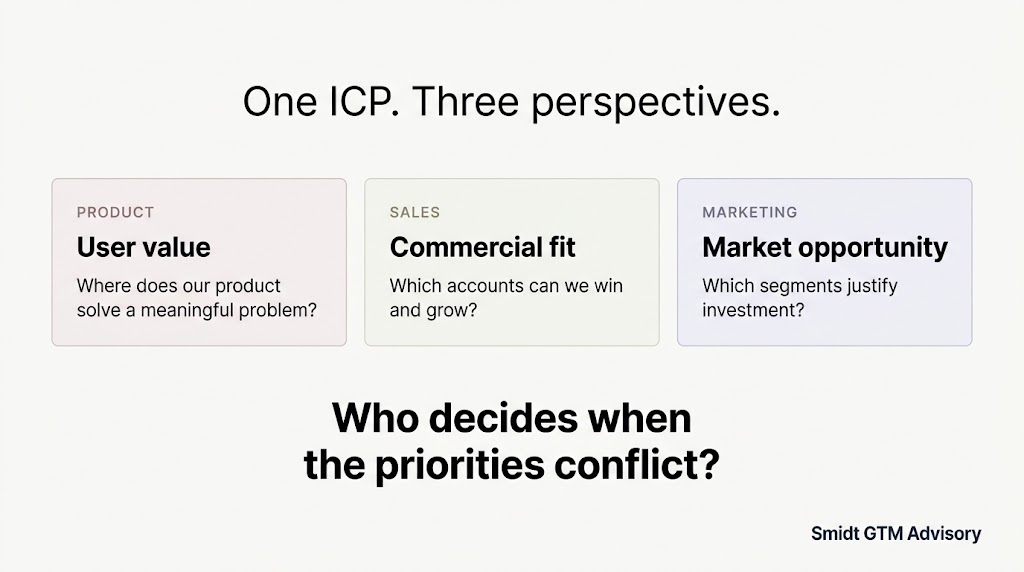
In a previous leadership role, I saw product, sales and marketing describe the ideal customer from three different perspectives.
Product focused on where users gained the most value. Sales focused on accounts it could win and grow. Marketing focused on segments that justified investment. Each view was valid, but nobody clearly owned the shared ICP or the process for changing it.
The result was diffuse targeting, inconsistent messaging and recurring friction. I tried to clarify each team’s responsibilities. The lesson was simple: shared input still needs explicit decision authority.
The problem: unclear authority slows execution
This problem extends beyond the ICP. Many critical GTM decisions cross functional boundaries: positioning, segment priorities, investment allocation, pipeline definitions and expansion motions.
Gartner reported that 84% of marketing leaders and employees experienced high levels of cross-functional collaboration drag, including unclear decision authority. Organisations with high collaboration drag were 37% less likely to meet revenue goals.
Unclear authority is an operating-model problem, not a hiring problem. But a leadership search is a valuable moment to address it. Otherwise, the new leader inherits the ambiguity along with the target.
Source: Gartner — Cross-Functional Collaboration.
Source note: Gartner published these findings in 2024, based on a 2023 survey of 329 marketing leaders and 78 leaders from other functions. The research is not specific to European B2B software companies. The 37% figure refers to a lower likelihood of meeting revenue goals, not 37% less revenue, and indicates association rather than causation.
Define the mandate before starting the search
A typical job description lists responsibilities, experience and broad outcomes. A leadership mandate goes further. It defines the business change, decision authority, dependencies, escalation route and measures of progress.
ghSMART’s scorecard method provides a useful foundation: define the role’s mission, outcomes and required competencies. For a cross-functional marketing role, add decision rights explicitly.
Framework: ghSMART — The Who Method.
“Build a world-class marketing function” is not a mandate. Neither is “own growth.” Moving upmarket, entering a region, repairing pipeline quality and improving expansion require different priorities, authority and support.
Six questions to define a marketing leadership mandate
- What must change? State the primary business problem, why it matters now and what should be different within a defined period. Separate early indicators from revenue outcomes that take longer to appear.
- Which decisions does the leader own? Specify whether the leader owns the ICP process, positioning, marketing investment, demand programmes, brand choices or the marketing technology roadmap. Ownership means authority within agreed boundaries—not responsibility for coordinating everyone else.
- Which outcomes depend on other teams? Name the contributions required from sales, product, customer success, finance and the CEO. A pipeline target may depend on sales capacity. Expansion may depend on product adoption data and customer-success motions.
- Who resolves cross-functional trade-offs? Name the executive sponsor and escalation route. If product, sales and marketing disagree on a target segment, who decides, using which evidence and by when? A meeting is not a decision mechanism unless it can produce a decision.
- What type of leadership is needed now? Choose between a permanent leader, an interim leader with a time-bound change mandate or another form of senior support. Base the choice on the work, urgency, clarity of the long-term role and the organisation’s ability to support it.
- What will count as progress? Agree the baseline, measures and review points. Combine commercial metrics with leading indicators such as decisions implemented, capabilities built and cross-functional commitments met.
Not every decision needs one functional owner. Some decisions should be shared or approved elsewhere. The mandate should make clear who owns, contributes, approves and resolves an impasse.
What stronger mandates look like
Signal AI’s public VP of Marketing specification offers a useful pattern: it defines success by quarter and links the role to measurable pipeline and operating outcomes. It is stronger than a generic list of activities, although it does not fully specify decision rights across marketing, sales, product and the CEO.
Public example: Signal AI — VP of Marketing role.
Compare the difference:
Weak: “Own pipeline growth and align marketing, sales and product.”
Stronger, illustrative mandate: “Over the first 12 months, establish a shared ICP and improve qualified pipeline from the agreed priority segments. The marketing leader owns the ICP process, positioning and marketing investment choices. Product and sales provide customer, usage and commercial evidence. Material changes to target segments require agreement from the CEO, CRO and product leader; the CEO resolves unresolved trade-offs. Progress is reviewed through agreed measures for segment quality, pipeline contribution and conversion.”
The exact decisions and measures will vary. The principle is consistent: connect accountability to authority and make dependencies explicit.
Use the mandate to improve the search
A clear mandate gives search partners and candidates the real assignment, not just a capability list. Candidates can assess the authority and support available; the company can assess how they would handle the actual trade-offs.
Use those trade-offs in interviews. Ask how a candidate would balance expansion revenue and new-logo acquisition, what evidence would justify reallocating budget and what they would agree with the CRO and product leader before accepting pipeline accountability.
Conclusion: hire for the mandate, not the title
Unclear decision authority affects existing leadership teams and new hires alike. A new appointment will not solve it by itself.
Before choosing the person, define the change, outcomes, decision rights, dependencies and escalation route. This will not guarantee success. It will, however, let the company hire for the real job and give the leader a fair basis on which to perform.
Before approving the next job description, ask: if this leader joined on Monday, which important decisions could they make without renegotiating the role? If the leadership team gives different answers, the mandate is not ready.